E-E-A-T stands for Experience, Expertise, Authoritativeness and Trustworthiness — the signals search engines and AI tools use to judge whether a source is credible enough to rank and cite. For a Hong Kong business, it is the difference between an AI engine mentioning you by name and quietly recommending a competitor it trusts more.
This is the Authority pillar. Structure lets engines understand you; authority is what makes them willing to repeat what you say.
What Does E-E-A-T Actually Mean?
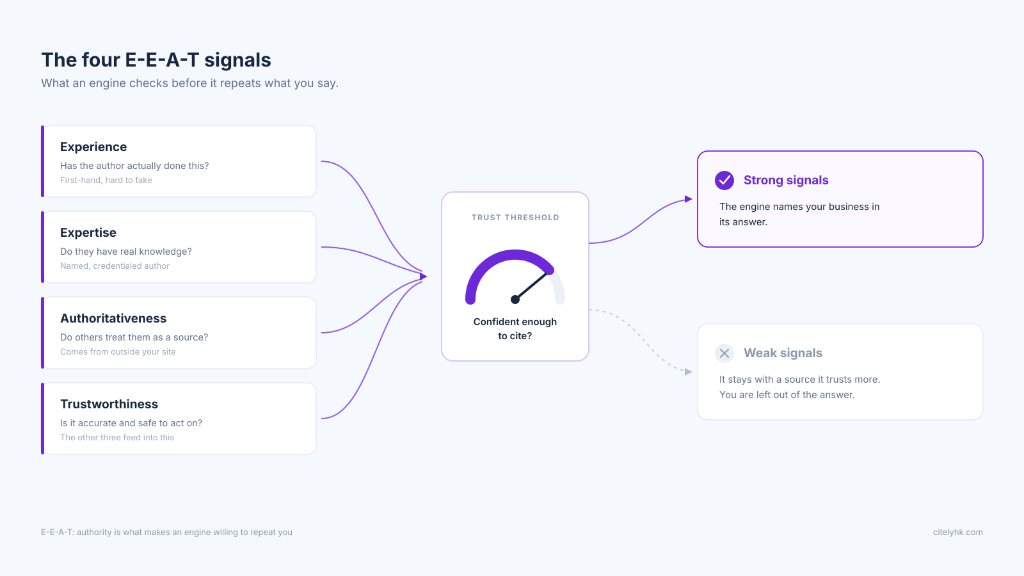
E-E-A-T is four separate signals, and each answers a specific question an engine asks about your content:
- Experience — has the author actually done the thing they are writing about? First-hand experience is weighted heavily, because it is hard to fake and hard to copy.
- Expertise — does the author have real knowledge or qualifications in the subject?
- Authoritativeness — is this business or person recognised by others as a go-to source? This is reputation, and it comes largely from outside your own website.
- Trustworthiness — is the information accurate, honest, and safe to act on? This is the signal the other three feed into.
The term comes from Google's Search Quality Rater Guidelines, but it now describes how AI answer engines behave too: they synthesise answers from sources they assess as credible, and credibility is exactly what E-E-A-T measures.
Why Does Authority Decide Who Gets Cited?
An AI engine answering a question is making a risk decision: whose information is safe to repeat? It has many sources saying similar things, and it will draw from the ones it trusts most. Authority is how it ranks that trust.
This matters more for AEO than it ever did for SEO. A search results page can show ten links and let the user judge. An AI answer names one or two sources and presents them as the answer — so the engine is far more conservative about who it cites. Weak authority does not push you to position eight; it removes you from the answer entirely.
For a Hong Kong business, the practical consequence is direct: two companies can offer the same service and publish the same claims, but the one with stronger authority signals is the one the AI names when a customer asks for a recommendation.
What Are the Signals AI Engines Read as Authority?
Authority is not one thing you switch on; it is an accumulation of signals across and beyond your website:
- A named, credentialed author. Content attributed to a real person with a described background outperforms anonymous content. The author needs a consistent identity — the same name, role and profile referenced across your site and linked to external profiles such as LinkedIn.
- Consistent entity information. Your business name, services and details stated the same way everywhere — your site, directories, and third-party mentions — so engines can confidently treat all of it as one entity rather than several uncertain fragments.
- External mentions and citations. Being referenced by other credible sources — press, industry sites, directories, reviews. This is the signal you least control and the one that carries the most weight, because it is other people vouching for you, not you vouching for yourself.
- Depth and consistency of content. Publishing substantive, accurate material on your subject over time signals genuine expertise rather than a one-off marketing page.
- Verifiable accuracy. Claims that check out, no misleading statements, clear contact and business information. Trust is lost fast when facts do not hold up.
How Do Hong Kong Businesses Build E-E-A-T?
Start with what you control, then work outward to what you do not:
On your own site, attribute every article to a named author with a real profile, connect that author to your organisation with structured data, and make sure your business details are stated consistently on every page. This is the structure layer doing the groundwork for authority — the two are linked, which is why schema markup and author markup matter here.
Beyond your site, the work is reputation: earning mentions from credible Hong Kong sources, maintaining accurate listings in relevant directories, collecting genuine reviews, and building a consistent professional presence for your key people. Two practical ways to earn these external signals are connecting and unifying your social profiles and running documented events that credible third parties reference. This work is slower and cannot be shortcut, which is precisely why it is defensible — a competitor cannot buy it overnight.
In both languages. For a Hong Kong business, authority in English does not transfer automatically to Chinese-language queries. Being recognised as a credible source across both English and Traditional Chinese is what makes you citable to the full range of your market.
Authority Is Earned, Not Configured
Structure and technical setup can be completed in weeks. Authority is the slower layer — it accumulates through consistent, verifiable, credited work over time. That is also why it is worth building deliberately: the businesses that establish authority now become the sources AI engines default to, and defaults are hard for later competitors to displace.
Want to know how your business's authority signals look to search and AI engines today? Get in touch — we will review where you stand and what is worth strengthening first.
Frequently Asked Questions
E-E-A-T stands for Experience, Expertise, Authoritativeness and Trustworthiness. It is the framework search engines and AI tools use to assess whether a source is credible enough to rank and cite. The extra "E" for Experience was added by Google in 2022 to emphasise first-hand knowledge.