Event marketing is not just a promotional channel — it is one of the fastest ways a Hong Kong business can generate the external mentions, structured content, and authority signals that search engines and AI tools use to decide who to cite. Most businesses treat an event as a one-day effort. This guide explains how to treat it as a long-term visibility asset.
This is a Trust-pillar piece. It builds on our social authority signals guide, which explains how external mentions carry the highest authority weight — events are one of the most reliable ways to earn them.
What Is Event Marketing in the Context of Search Visibility?
Event marketing is the planning and promotion of in-person or virtual experiences — launches, seminars, workshops, networking sessions, and branded activations — to connect with an audience and advance a business goal. In the context of search and AI visibility, an event does something most content cannot: it generates third-party references at scale.
Every media mention, partner post, attendee recap, and directory listing created around your event is an external citation — the highest-weight authority signal in both Google's E-E-A-T framework and AI answer engines' entity trust models. The event is the trigger; the citations are the visibility asset.
Why Do Events Create Search and AI Signals?
Search engines and AI tools weight external mentions above self-published content because they are harder to manufacture. When a credible Hong Kong media outlet covers your brand event, when a partner tags your business in a recap, or when an event directory lists your workshop — those are signals from outside your own domain that you are a real, active, credible entity.
This matters more for AEO than traditional SEO. An AI answer engine like ChatGPT or Perplexity does not list ten results and let the user choose. It names one or two sources and presents them as fact. Events accelerate the accumulation of the external signals that push your business into that cited tier — faster than blog posts alone can.
The table below shows the main event-driven visibility signals, what each one proves to an engine, how much of it is in your control, and roughly how much weight it carries:
| Signal | What it proves | Your control | Authority weight |
|---|---|---|---|
| Event schema markup | A real, dated, located event exists | Full | Medium |
| Event page with optimised content | Your business runs credible, searchable events | Full | Medium |
| Media coverage of the event | A third party verified your event happened | Low | Highest |
| Partner and attendee mentions | Others are associated with your brand | Low | High |
| Post-event recap content | The event produced genuine knowledge or experience | High | Medium |
| Event directory listings | Your event is indexed by credible third-party platforms | Medium | Medium |
The pattern mirrors social authority: the signals you fully control carry moderate weight, and the ones you least control — third-party media and attendee mentions — carry the most. Events are one of the few marketing formats that generate both simultaneously.
How to Turn an Event Into a Lasting Visibility Asset: A Practical Sequence
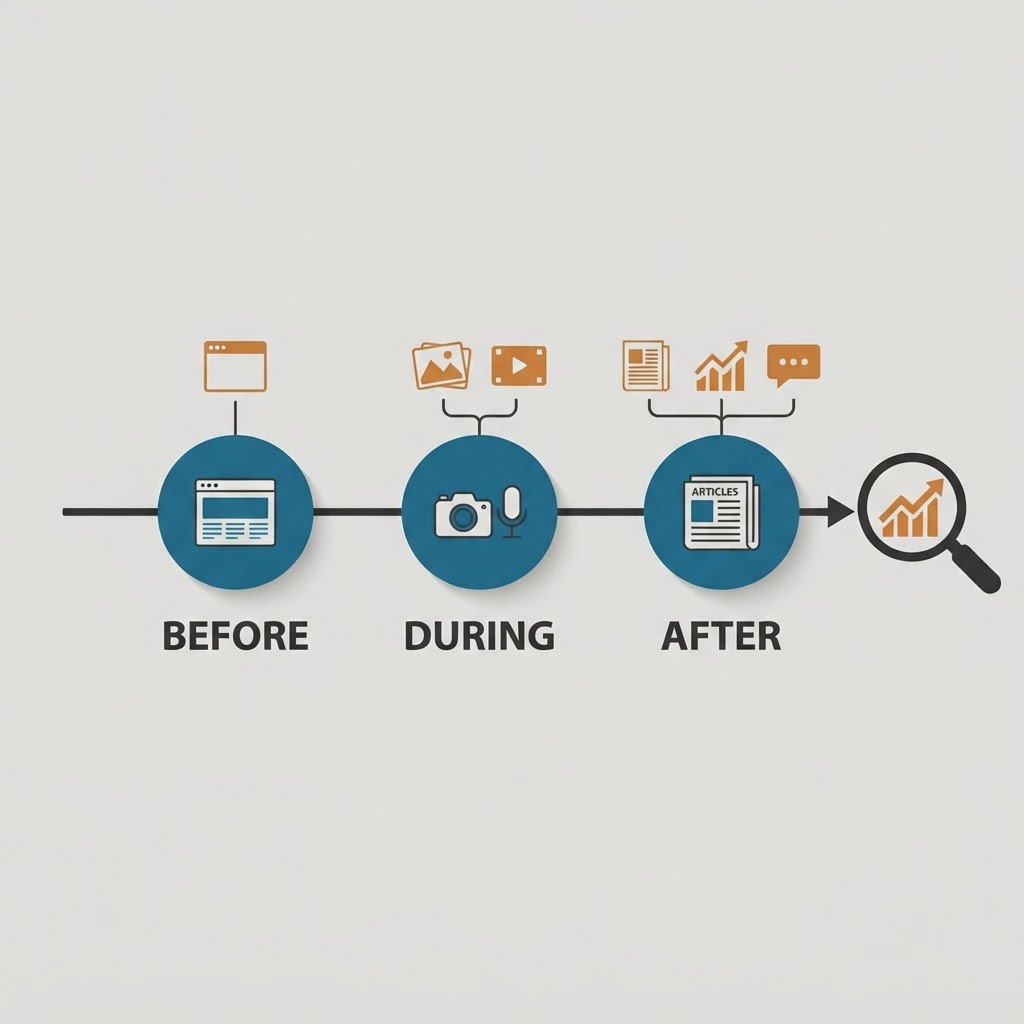
Work from structure outward to earned signals. The order matters.
- Add Event schema markup to every event page. Before anything else, mark up your event page with Event structured data — name, date, location, organiser, and description. This tells Google and AI tools that a real, specific event exists, and it is the foundation that makes every other signal legible. Without it, even well-covered events are harder for engines to attribute correctly to your business entity.
- Optimise your event landing page for search. Your event page should answer the questions someone would search: what the event is, who it is for, what they will learn or experience, when and where it happens, and who is running it. Include your named speakers or hosts with consistent titles — this connects the event to real, credible people and strengthens E-E-A-T signals. The page should remain live after the event as a post-event recap, not be deleted.
- Distribute to event directories and partner channels. Submit your event to credible Hong Kong event directories and brief your partners, sponsors, and speakers to list and link to the event from their own platforms. Each listing and mention is a third-party citation that corroborates your event — and by extension, your business — to engines crawling the web.
- Generate structured post-event content. After the event, publish a substantive recap: key insights shared, speaker highlights, what participants said, and what the event demonstrated about your business's expertise. This content has a long shelf life — it continues to attract search queries about the topic long after the event date has passed, and it gives AI engines a citable summary of what your business knows and does.
- Earn external coverage and mentions. The highest-weight signal is the one you do not write yourself. Brief local media, invite industry journalists, and give attendees content worth sharing. A single article from a credible Hong Kong outlet mentioning your event does more for entity trust than ten self-published recaps.
What to Avoid
Some common event marketing approaches actively reduce search visibility rather than building it:
- Deleting the event page after the event. A post-event page with a recap is an evergreen search asset. Deleting it removes the only page engines can index and cite for that event.
- Running events under an inconsistent brand name. If your event uses a different name, logo, or description than your main business entity, engines cannot connect the two. Consistency is the signal; variation is the red flag.
- Skipping schema markup. An unstructured event page is invisible to engines parsing structured data. It will rank only if the content itself is strong — and even then, it will not benefit from Event rich results in Google Search.
- Treating the event as a one-day effort. The visibility value of an event compounds over weeks: post-event content, delayed media coverage, and attendee posts continue to generate signals long after the room has emptied.
- Focusing only on attendance, not documentation. An event that is not documented — no recap, no photos, no write-up — generates almost no lasting search signal. The event happened; the web does not know it.
Do This in Both Languages
For a Hong Kong business, event visibility in English does not automatically extend to Chinese-language queries. Your event pages, schema markup, post-event recaps, and directory listings should be consistent and complete in both English and Traditional Chinese. This doubles the surface area of your event across your full market's search behaviour — and it is a direct visibility advantage over competitors who publish only in one language.
Event marketing builds search and AI visibility in a way most content formats cannot match — not because events are louder, but because they generate the external, third-party signals that engines trust most. Structure the event correctly, document it well, and distribute it consistently, and a single event can produce visibility signals that compound for months.
Want to know how to structure your next event for maximum search and AI visibility? Get in touch — we will map your event strategy to your visibility goals.
Frequently Asked Questions
In the context of SEO and AEO, event marketing is the practice of planning and running events in a way that generates structured search signals — Event schema markup, optimised event pages, post-event content, and external citations from media and partners. These signals help search engines and AI tools confirm your business is a credible, active entity worth citing.