Schema markup is a small layer of code added to your website that tells search engines and AI tools exactly what your business is — your name, services, location and expertise — in a format machines can read with certainty. You don't need to write it yourself, but in 2026 your Hong Kong business does need to have it.
What Is Schema Markup, in Plain Language?
Imagine your website is a shop in Causeway Bay. Human visitors can look through the window and figure things out: the signage, the products, the prices, the atmosphere. Machines cannot. A search engine or an AI assistant reading your website is like someone glancing at your shopfront in a language they only half understand — they get the general idea, but they guess at the details.
Schema markup (also called structured data) is signage written in the one language every engine reads fluently. It sits invisibly in your website's code and states the facts plainly: this is a business, its name is X, it offers these services, it operates in Hong Kong, this page answers these questions, this article was written by this person.
Visitors never see it. Google, ChatGPT, Perplexity and Google AI Overviews absolutely do — and it changes how confidently they can talk about you.
Why Schema Markup Is One of the Fastest AEO Wins
In our first article on AEO and SEO, we explained that Answer Engine Optimisation is about being cited in AI answers, not just ranked in search results. For an AI engine to cite your business, it first has to be sure what your business actually is.
That is the job schema markup does. Without it, an engine has to infer your details from paragraphs of marketing copy — and engines are cautious about facts they have inferred. With it, your name, services and location become verifiable data the engine can repeat with confidence.
This is why schema markup is one of the fastest AEO wins available: unlike building authority or earning mentions, which take months, structured data is something you control completely and can implement this week. It will not earn citations by itself — content quality and authority still decide who gets named — but it removes the ambiguity that stops engines from naming you at all.
What Does Schema Markup Actually Look Like?
You never have to write this, but seeing a small piece makes the whole concept click. Here is a simplified example for an imaginary restaurant:
{
  "@type": "LocalBusiness",
  "name": "Wong's Dim Sum",
  "servesCuisine": "Cantonese",
  "address": "Mong Kok, Hong Kong"
}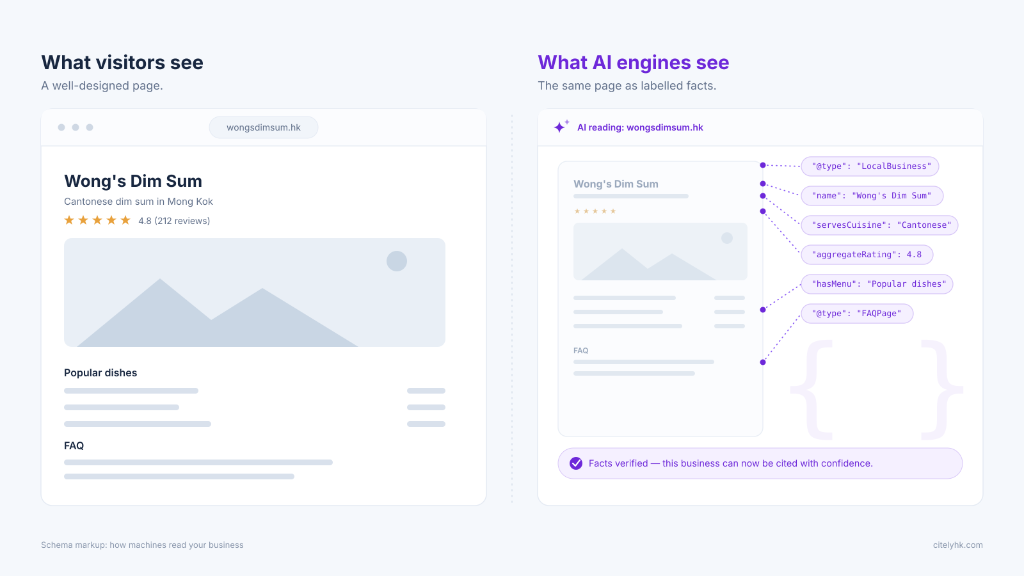
Read it line by line and it is exactly what it looks like: this page is about a local business; its name is Wong's Dim Sum; it serves Cantonese food; it is in Mong Kok, Hong Kong. No interpretation needed, no guessing. When someone asks an AI "where can I get dim sum in Mong Kok?", this restaurant is now a fact the engine holds, not a paragraph it has to decode.
Which Schema Markup Types Matter Most for Hong Kong Businesses?
There are hundreds of schema types, but a typical Hong Kong business needs a small, well-connected set:
- Organization or LocalBusiness. The foundation — your business name, logo, location and contact details. Every other piece of schema on your site should point back to this one entity.
- Service. Describes what you actually offer, so engines can match your business to service-related questions rather than just your brand name.
- FAQPage. Marks up question-and-answer content in the exact format answer engines love to lift. If your pages answer real customer questions, this makes those answers machine-readable.
- Article and Person. For your blog and its authors. Engines increasingly weigh who wrote something; connecting each article to a named, described author is a direct E-E-A-T signal.
- BreadcrumbList. Tells engines how your pages relate to each other, which helps them understand your site's structure — and can improve how your pages appear in results.
The real power is not any single type — it is the connections between them: the article written by the person who works for the organisation that offers the service. That connected graph is what turns scattered pages into one credible entity.
Does Schema Markup Improve Your Google Rankings?
Here is the honest answer most agencies skip: schema markup is not a direct Google ranking factor. Adding it will not move you from position eight to position three by itself.
What it does instead is arguably more valuable in 2026. First, it makes your pages eligible for rich results — ratings, FAQs, breadcrumbs and other enhanced listings that earn more clicks at the same ranking. Second, and increasingly more important, it is how AI engines extract reliable facts about your business. Rankings decide whether you are found; structured data shapes whether you are understood — and being understood is the entry ticket to being cited.
How to Get Schema Markup Without Writing Code
You have three realistic routes, in increasing order of quality:
- Use your website platform's built-in options. Most modern builders and CMS plugins can generate basic Organization and Article schema automatically. It is generic, but far better than nothing.
- Use a free schema generator. Tools that let you fill in a form and produce the code, which you paste into your site. Always check the result with Google's Rich Results Test or validator.schema.org — half the schema on the web fails validation, and broken markup helps nobody.
- Have it built as a connected system. Single-page schema is easy; the value is in the graph — consistent identifiers linking your organisation, people, services and articles across every page, in both English and Traditional Chinese. That cross-page consistency is where DIY setups usually break down, and it is the part worth doing professionally.
Structure Comes First
Everything else in AEO — authority, mentions, trust — is built on engines being certain of who you are. That is why structure is the first layer of the work we do at Citely, and why schema markup is the highest-leverage starting point for a Hong Kong business that wants to be visible in AI answers.
Want to know whether your website's schema markup exists, validates, and actually connects? Get in touch — we will take a look and tell you plainly where you stand.
Frequently Asked Questions
No, not directly. Google has confirmed structured data does not boost rankings on its own. Its value lies in making your pages eligible for rich results, which improve click-through, and in giving AI engines verifiable facts about your business — which is what makes citations in AI answers possible.