Answer first: Yes — a clear, specific, up-to-date privacy policy is now a measurable trust signal for AI engines. ChatGPT, Perplexity, and Google AI Overviews weigh how transparently a business explains what data it collects, why, and who it shares it with before deciding whether that business is safe to cite or recommend. A vague or missing privacy policy doesn't just risk a PDPO complaint in Hong Kong — it quietly disqualifies you from AI-generated answers.
Why AI engines care about your privacy policy
AI engines are built to avoid recommending sources that could expose users to risk. When a model is deciding whether to cite your business — for a service recommendation, a "best of" list, or a direct answer — it's effectively running a lightweight risk check. Part of that check is whether your site treats visitor data honestly and openly. A privacy policy that's copy-pasted, outdated, or written to obscure rather than inform reads as a legitimacy gap, the same way a missing "About" page or unverifiable contact details would.
This isn't speculation about how models "feel." It's a direct extension of E-E-A-T: Trust is one of its four pillars, and data handling is one of the clearest, most checkable proxies for trustworthiness a machine can evaluate without human judgment. A document is either specific and current, or it isn't.
What "clear terms" actually means in practice
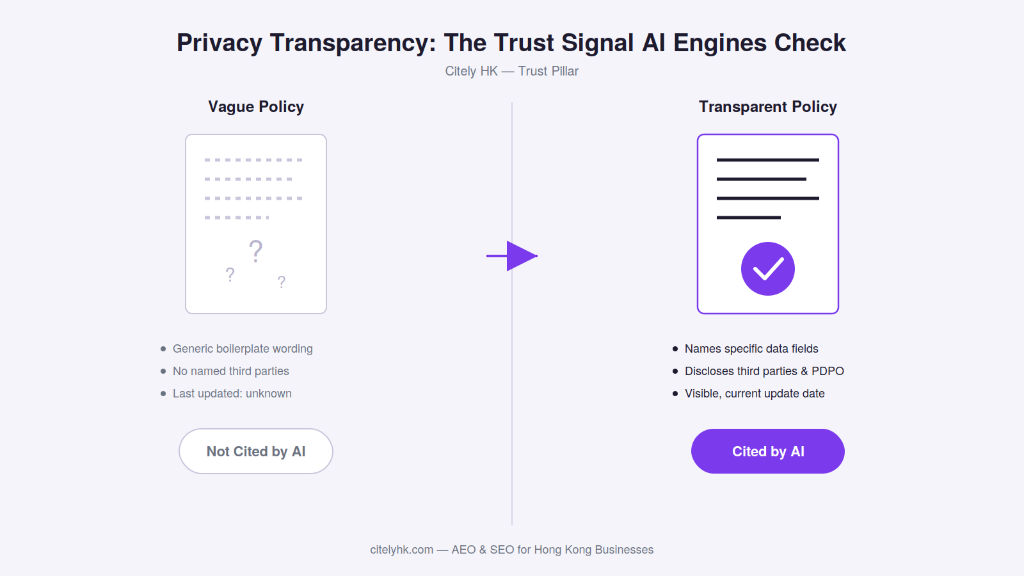
Vague privacy policies tend to share the same problems: generic boilerplate language, no mention of which specific data fields are collected, no explanation of third-party sharing, and a last-updated date from years ago. A transparent policy, by contrast, is specific and current. Here's the distinction that matters:
| Vague Policy | Transparent Policy |
|---|---|
| "We may collect information you provide" | "We collect your name, email, and phone number when you submit our contact form" |
| No mention of third parties | Names specific tools (e.g., analytics, CRM, payment processor) and what each receives |
| No PDPO reference | Explicitly states compliance with Hong Kong's Personal Data (Privacy) Ordinance |
| Last updated: unknown or years old | Visible "last updated" date, reviewed annually |
| Buried in a footer link, small text | Linked from footer, contact page, and any data-collection form |
The Hong Kong context: PDPO matters for AEO too
Hong Kong's Personal Data (Privacy) Ordinance (PDPO) already requires businesses to state clearly what personal data they collect and how it's used. Most businesses treat this as a legal box-ticking exercise. What's changed is that this same document is now also functioning as an AI-readable trust artifact. A privacy policy that satisfies the PDPO's Data Protection Principles — collection, accuracy, retention, use, security, and access — happens to be exactly the kind of specific, structured content that gives AI engines confidence to cite a business.
In other words: doing PDPO compliance properly is no longer just a legal safeguard. It's now part of your Answer Engine Optimisation groundwork.
How this connects to your other Trust signals
This piece builds directly on our Trust Signals cornerstone and complements the credibility work covered in E-E-A-T Explained. Where E-E-A-T covers who you are and Trust Signals covers what proof you offer, privacy transparency covers how you handle the people who trust you with their data — a signal that's easy for AI systems to verify and easy for businesses to overlook.
A practical checklist for HK businesses
- Name the specific data fields you collect — not "information," but "name, email, phone, browsing behaviour," etc.
- List every third party that receives data — analytics tools, CRMs, payment processors, marketing platforms.
- State your PDPO compliance explicitly , referencing the six Data Protection Principles where relevant.
- Show a visible last-updated date and review the policy at least annually.
- Link it prominently — footer, contact forms, checkout pages, not buried three clicks deep.
- Match your cookie banner to your policy — inconsistency between the two is a red flag AI engines and users both notice.
The bottom line
Your privacy policy used to be read almost exclusively by lawyers and the rare cautious customer. Now it's also being parsed — directly or indirectly — by the AI systems deciding whether your business deserves a citation. Treating it as a transparency document rather than legal boilerplate is a low-effort, high-leverage move within the Trust pillar.
Frequently Asked Questions
AI engines and their crawlers can access and parse any publicly available page, including privacy policies. Even where a model doesn't cite the policy directly, its clarity and structure feed into broader trust signals the model uses when deciding whether to reference a business at all.